

Investing in your health is the most important decision you can make. Perhaps you’ve been thinking for some time about having a really thorough check-up, or perhaps you’re looking for complete peace of mind and preventive reassurance regarding your health. A medical screening That, then, is the first, crucial step you need to take. But what happens once the tests are over and the doctors have carried out the analyses? The tangible and most valuable outcome of a medical check-up is your personal medical record. It is not just a digital folder full of incomprehensible medical terms and abstract figures, but a personal guide and blueprint for a healthy life. We’ll take you through Doctor's House Antverpia I’d like to walk you through, step by step, what you can expect after your medical check-up.
What does a medical check-up at Doktershuis Antverpia involve?
A medical check-up is not a standard visit to the doctor. It is an in-depth, proactive and preventative health assessment that is fully tailored to your unique profile. Your programme is based on your age, your daily lifestyle, your stress levels and any family risk factors.
The aim of this preventive medicine is to detect any potential health risks or latent conditions before they cause physical symptoms.
What exactly do we look for during the screening?
So, when you choose one of our tailored care packages, you’re opting for scientifically-backed prevention. Our programmes, from the Cardio Check to the Vital Check, are modular and tailored to your health profile. Nevertheless, the philosophy behind every medical screening is the same. Our doctors We always work according to a set and logical step-by-step plan, starting with you as a person.
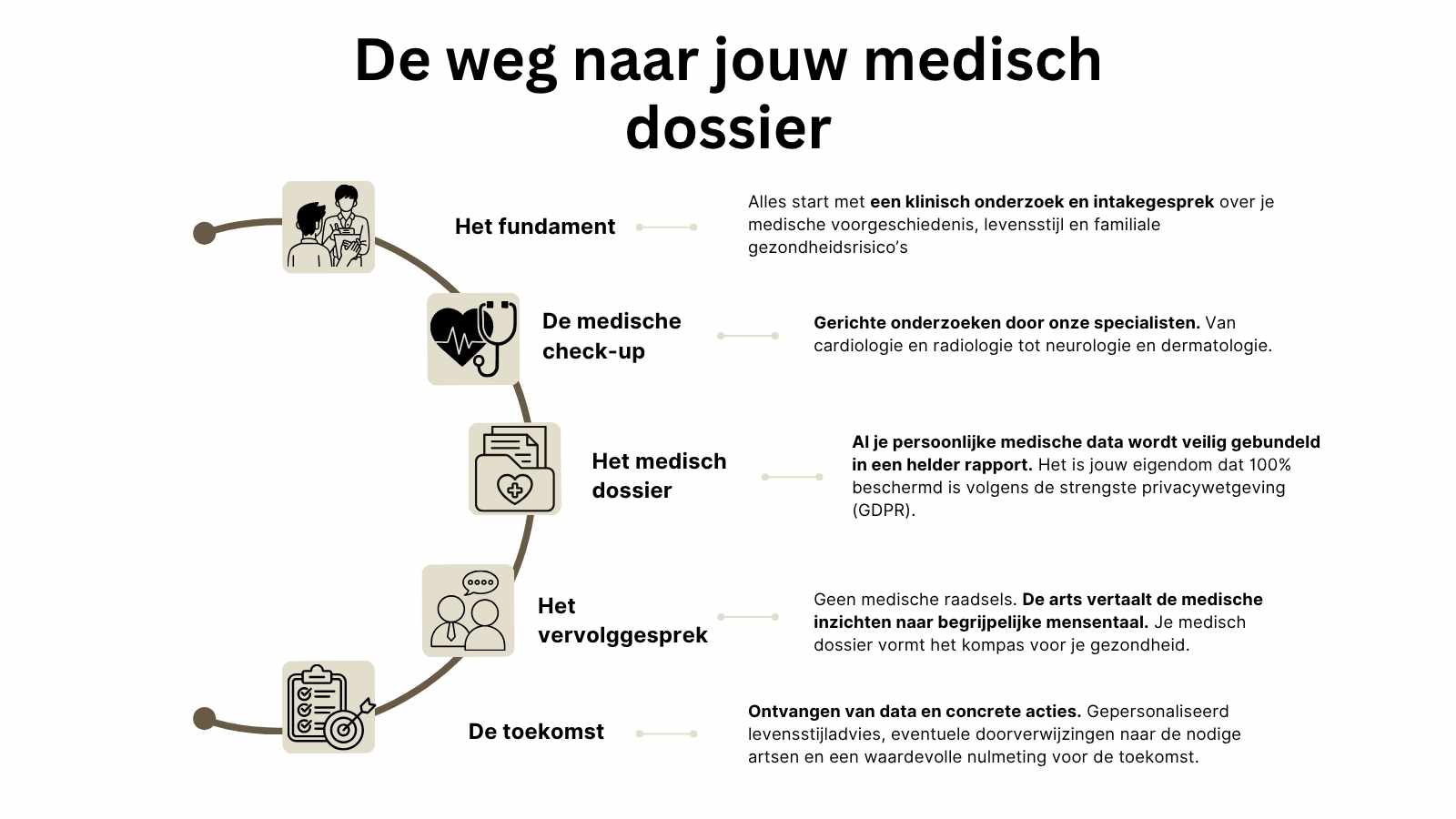
Step 1: The foundation – Clinical examination and targeted consultations
We do not believe in a one-size-fits-all approach to diagnosing illnesses and treating patients. Every medical screening therefore begins with a thorough initial consultation, a clinical examination and the necessary specialist consultations. Before a single machine is even switched on, our doctors listen carefully to your story.
- The clinical trial: We will assess your medical history, family risk factors, current lifestyle, stress levels and any sector-specific workload.
- Targeted consultations: Depending on the programme you have chosen, you will begin with targeted consultations. This may involve a consultation at the cardiologist, but also from our specialists such as gastroenterology, neurology or dermatology. This personal contact ensures that the doctors can examine the subsequent individual tests with a focused, discerning eye.
Step 2: Going into more depth – Effective medical examinations
Only once the doctors have clearly established the clinical picture and the priorities do they begin the actual investigations. As we take a holistic approach to the body rather than focusing on a single discipline, we carry out a wide range of advanced diagnostic tests.
- Cardiology and pneumology: We measure your heart’s condition and electrical activity via an electrocardiogram at rest and during an intensive cycling test. We supplement this with an echocardiography and a pulmonologist pulmonary function test to test your lung capacity.
- Gastroenterology and urology: Preventative screening of the digestive system and abdominal organs via stool test or a preventative colonoscopy. In addition, we also carry out specific urological examinations such as a uroflow.
- Vascular surgery and radiology: By means of ultrasounds Using radiological imaging, we look deep beneath the skin. Our vascular specialists assess the condition of your blood vessels to minimise the risk of atherosclerosis or thrombosis.
- Neurology: An assessment of how your nervous system and brain functions work. This is essential for the early detection of neurological risks or symptoms of chronic fatigue.
- Gynaecology: Specific and preventive check-ups for women, focusing on intimate health, hormonal balance and the early detection of cancer.
- NKO and ophthalmology: A thorough check of your senses through targeted hearing tests and advanced eye screenings to ensure overall vitality.
Thanks to this unique and personalised approach, in which clinical research specifically determines which tests are effective for you, we do not misuse this data; on the contrary, we collect it. These insights are therefore essential for your long-term health and vitality.
Who is this check-up intended for?
Our preventive medical screenings are designed for anyone who wants to take control of their own vitality. From busy entrepreneurs and managers who want to prevent their bodies from being overworked to recreational or professional athletes who want to safely push their limits. But you’re just as welcome if you simply want to keep an eye on your health so you can age healthily. Prevention There’s no age limit.
What happens immediately after the screening?
Once the final examination or scan has been completed, you, as a patient, won’t have to wonder what happens next. One of the biggest advantages of Doktershuis Antverpia is that we have all medical disciplines and equipment under one roof. This means you don’t have to travel from one hospital to another laboratory. All test results are also collected centrally and digitally within our practice.Immediately after the screening, the behind-the-scenes process begins:
So what will actually be included in your medical records following a medical screening?
Once you have completed the medical screening and our doctors have held their consultation, your comprehensive medical record will be compiled. It will then be one of the most comprehensive health records you can have. Because our screenings As we take a multidisciplinary approach, your medical file is not just a brief doctor’s note, but an encyclopaedia of your current state of health. That is why, at Doktershuis Antverpia, we provide you with a comprehensive overview of everything that happens after the medical check-up will be recorded and documented in your medical records.
1. Medical history and clinical parameters
The file begins with the results of the general clinical examination and your medical history. This provides the context for all subsequent data.
- Medical history and family history: Chronic conditions, previous operations and hereditary risk factors.
- Lifestyle profile: Records of your diet, sleep quality, alcohol and tobacco use, weekly physical activity and stress factors.
- Basic biometric data: Your exact height, weight, BMI, waist circumference and how these have changed over time.
- Vital signs: Repeated blood pressure readings and your resting heart rate.
2. The comprehensive laboratory report
The results of thorough blood, urine and, where appropriate, stool tests are presented clearly in tables and graphs, including the medical reference values.
- Haematology and coagulation: A complete blood count, including white and red blood cells, platelets and clotting time.
- Metabolic and lipid profile: Total cholesterol, HDL, LDL, triglycerides and your fasting blood sugar level, together with your long-term blood sugar levels.
- Organ functions: Your kidney and liver function. And also the acidity of your urine.
- Hormonal balance and the thyroid: Thyroid hormones and sex hormones, if relevant to your check-up.
- Vitamins, minerals and inflammation markers: Levels of vitamin D, B12 and iron stores, and CRP (C-reactive protein) to detect latent inflammation in the body.
- Preventive screening tests: Prostate screening in men and the results of the immunochemical faecal test.
3. Organic and functional research reports
Every specialist who has examined you adds a formal and detailed report to your medical records.
- Cardiology and respiratory report: It contains the protocol and the graphs showing your resting heart rate ECG, the full report on cardiology cycling test, the results and measurements from echocardiography and the graphs and parameters of spirometry.
- Gastroenterological and urological report: The findings of the abdominal examination, and, if it was carried out as part of your care package, also the visual report of the preventive colonoscopy.
- Vascular and radiological records: The ultrasound images and written interpretations of your blood vessels, including any calcification that may be present.
- Neurological assessment: Recording of reflexes, nerve pathways and any indicators of cognitive or neurological overload.
- Gynaecological records: Report on the screening smear tests, breast examination and gynaecological ultrasound scan.
- ENT and ophthalmic data: The detailed audiogram and the ophthalmological report.
- Body composition: A detailed visual report of your exact bone density, fat mass and muscle mass for each part of the body.
- Dermatological report: The results of the dermatoscan, including digital photographs and a map of your moles for future comparisons.
4. The multidisciplinary synthesis and the preventive action plan
This is the most important part of your medical record. The coordinating doctor brings all the above information together to form an overall conclusion.
- Your health score and risk profile: A clear summary of your cardiovascular risk and any metabolic or oncological issues requiring attention.
- Medical advice and treatment plan: If any abnormalities have been found, this section sets out exactly which medication, further diagnostic tests or internal referral is required.
- Personalised lifestyle and vitality plan: Specific, personalised guidelines for your diet, exercise, supplements and stress management, based on the deficiencies or areas for improvement identified in the tests.
As this list of data and your medical records are generally quite complex and technical, we will never leave you to deal with them on your own. Once all the reports and findings have been finalised, we will arrange a detailed follow-up consultation with you and your treating doctor. During this consultation, you’ll go through your file together; the doctor will explain the medical terminology in clear, everyday language where necessary, and you’ll have plenty of opportunity to ask questions. You’ll leave our centre Not a file full of mysteries, but a clear guide to your health.
Are you actually entitled to access such a medical record?
It’s a question our doctors are often asked. And according to Belgian law A resounding ‘Yes’. As a patient, you are the owner of this comprehensive information about your own body. The law therefore stipulates that you are always entitled to:
Privacy and access: Who is allowed to view my medical records?
When it comes to medical data, privacy is a fundamental right. The legal provisions and the code of ethics for doctors are therefore very strict in Belgium. But how does this work in practice? Who is actually allowed to access your medical records, and who isn’t?
Can all doctors just read my medical records?
No, certainly not. The Act states that a doctor may only have access to your medical records if there is a direct treatment relationship.
If you have a medical check-up at Doktershuis Antverpia, the cardiologist, the radiologist and the coordinating doctor who carried out your screening will have access to this data. A doctor or specialist, whether within or outside our practice, who is in no way involved in your medical screening or treatment, is not permitted to view your medical records for privacy reasons.
Are receptionists or the medical secretariat allowed to view my medical records?
This is a common concern. The answer to this is clear and strictly separate.
Medical secretaries and receptionists play a crucial logistical role and, just like doctors, are bound by strict professional confidentiality.
- They have access to your administrative and logistical details in order to organise and ensure that your visit runs smoothly and efficiently.
- They do not have systematic access to your detailed medical diagnoses, specialist reports or the specific results of your blood tests. Unless this is strictly necessary, for example, to send or archive a report securely at your explicit request.
At Doktershuis Antverpia, we therefore apply the strictest GDPR security protocols, ensuring your data is fully protected from prying eyes.
What happens after the medical record? From data to action
The medical record is not the end of the line, but the start of a targeted journey towards better health. The ultimate aim of a preventive health check-up It’s not just about collecting the data, but above all what you do with that knowledge afterwards.
1. Personalised lifestyle advice
If your medical records show that certain readings are not optimal – for example, due to early-stage insulin resistance, high blood pressure or a vitamin deficiency – this information is immediately put into practice. You’ll receive practical, scientifically-backed advice on diet, exercise, stress management and any supplements needed to bring your levels back into the green zone.
2. Immediate internal referral where necessary
Should a specific medical issue come to light during the medical screening that requires further clinical care, you won’t need to look for a specialist yourself. Thanks to our unique internal structure, we can refer you directly to the right experts for prompt and targeted treatment.
3. A valuable baseline measurement for the future
Your medical records are the perfect reference for the future. If you decide to have a check-up in a year or two’s time, then they’ll our doctors your new results right next to your old records. This allows them to analyse health trends, see whether lifestyle changes have had an effect, and continue to monitor your long-term health accurately.
Conclusion: Take control of your health
The result of a medical screening It is so much more than just a collection of medical documents. Your medical record forms the foundation for a healthy, energetic and long life. It offers you a unique opportunity to take control of your own body. And all of this is backed up by hard medical facts and the personalised, professional guidance of our specialists. Are you curious to find out how your health is really doing? Do you want to stay one step ahead of any potential health risks and have a clear baseline assessment of your body carried out? Then book your appointment today contact Book your personalised medical check-up with us. Or plan this yourself and discover the power of preventive medicine.
Stay tuned
Stay up-to-date with current developments and insights within medical care. On our blog page, we share clear and reliable information on health, prevention and general medical topics. This gives you more insight and support to make informed choices around your health in an accessible way.
Make an appointment today
A stronger focus on prevention helps prevent disease, reduces pressure on care and keeps the system affordable. Investing in health before illness means more quality of life and a more sustainable future for all.
A close-knit team of specialists, where reliable care and a personalised approach are key.